7 Platforms for Managing AI Agent Teams
Seven tools to organize your AI agents, manage spending, and keep important decisions in your hands.
 Paperclip · 20 min read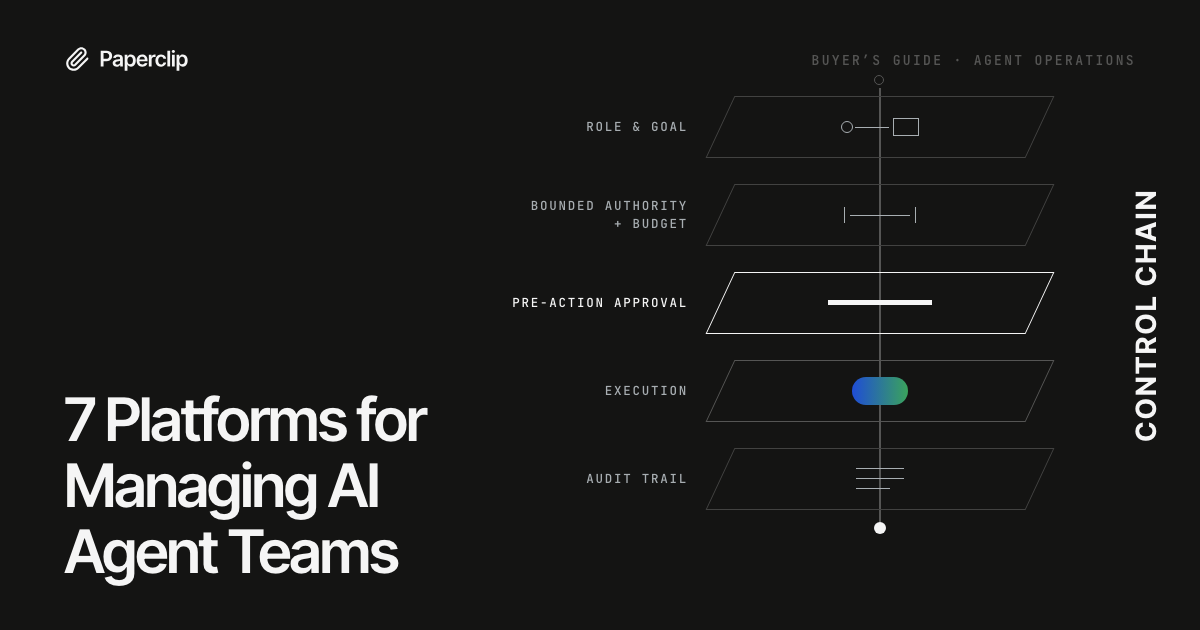
TL;DR
- An agent-management platform can take on work you may already do by hand: assigning tasks, tracking costs, handling approvals, and checking results. These seven tools cover different parts of that job.
- Spending limits and approval rules deserve an early look. Can you stop one agent from running up costs? Can you require someone to approve a deployment before it happens?
- Seeing what happened or connecting agents does not, by itself, give a team spending limits or required human decisions. Choose which jobs to keep doing manually, which to adopt a tool for, and which truly need custom engineering.
When managing agents becomes a job
Imagine several Claude Code and Codex sessions working across your repositories. One is waiting for a decision. Another is repeating work an agent finished yesterday. You’re moving between windows to check results, track costs, and remember who was supposed to do what. This is an illustrative setup, not a customer account.
The sessions may each be useful. Keeping them useful together has become another job. Before you add an agent-management platform, decide which part of that job you need help with: organizing work, limiting spending, controlling access, or getting a decision before an agent acts.
This guide compares Paperclip, Tasklet, LangSmith Fleet, CrewAI, Grok Bot, Raft, and LobeHub as different ways to manage agent work. It helps you narrow the field and choose what to keep, adopt, or build. For more on the category, see What Is an AI Agent Control Plane?.
When the work keeps running
A session you supervise closely may need little more than a task list and a review before you use its output. Longer-running work creates more decisions: should an agent keep retrying a failed job overnight, use a production credential, or send the message it just drafted?
The tools for these jobs have different names. Monitoring, often called observability, helps you see what ran and diagnose failures. Access permissions determine which tools and data an agent may use. Approval controls hold a specified action until someone decides whether it can proceed. Audit records preserve who requested, approved, and performed work, along with the result.
You may need more than one of these. A record of an expensive retry loop helps explain the bill; a spending limit should stop further work. A tool connection lets an agent reach your email service; an approval rule can require a person’s decision before a message goes out. Ask how the pieces work together for the action you care about.

Should you build this yourself?
Connecting agents is a reasonable first experiment. Maintaining the system around them is a separate commitment. Someone must keep permissions current, enforce budgets, route approvals, recover failed work without repeating completed actions, and preserve useful records as tools change.
- Keep a simple session setup when you can still track the work, check spending, and review consequential actions yourself. A shared task list and clear handoffs may solve the immediate problem.
- Adopt an existing tool when those management jobs recur and take time from the work you actually want to ship. Test the controls you need before committing; a polished dashboard may still leave you handling approvals or costs elsewhere.
- Build custom infrastructure when you have unusual requirements that existing tools cannot meet and an engineering owner for the ongoing work. Include upgrades, failures, access changes, and record retention in the estimate, not just the first successful run.
Adopting and extending open source is a middle path. You can start with working coordination and add the missing parts, subject to the license. Self-hosting still leaves you responsible for deployment, updates, backups, and access. For a small engineering team, time spent maintaining agent infrastructure is time it cannot spend on its own product. That tradeoff deserves the same attention as subscription and model costs.
The decision rubric
Use these six questions in a trial. The examples are tests to request, not claims that every product supports them.
-
Role and goal. If two agents pick up the same bug, can you tell who owns the task and which goal it serves? Look for an assignment that persists after the session ends.
-
Access permissions. Can a documentation agent read a repository without getting permission to deploy it? Check who can grant and revoke access to tools, accounts, and data.
-
Usage control. If an agent keeps retrying overnight, which limit catches it: agent, API key, workspace, account, or plan? Does work stop, pause, ask for approval, or continue into paid overage? A request or time limit can bound activity without setting a monetary cap.
-
Approval control. Ask for a deployment to wait for a named person. What triggers the pause, and can anyone bypass it? Check rejection and a changed request too. A notification after completion cannot prevent the action.
-
Execution. Where does the work run: the vendor’s service, your computer, or a connected agent runtime? Check what happens to a running task when you revoke access or restart the service.
-
Audit record. After that deployment, can a teammate find the task, requested action, decision, result, and cost? Ask for an export and check which records you must join yourself.

Comparison table
Start with spending limits and required approvals. Open the full rubric for ownership, access, execution, and work records. A documented control may cover only specific actions or plans; read its scope alongside the verdict.
Each cell names the documented mechanism; its mark reports the evidence verdict. Meets means the documentation establishes the control; partial names a material gap; does not meet means the documented mechanism falls short; unverified means the documentation does not establish the capability either way.
The two controls to inspect first
- Meets
- Partial
- Does not meet
- Unverified
- PaperclipAgent-management platformUsage controlPer agent · pauses at budget limitApproval controlGoverned actions · blocking human gate
- TaskletAgent automation platformUsage controlPer agent · credit capApproval controlPermissioned actions · blocking human gate
- LangSmith FleetAgent build & management platformUsage controlWorkspace + gateway agent-key caps · verify Fleet coverageApproval controlSelected tools · central blocking inbox
- CrewAIAgent frameworkUsage controlActivity limits · no documented monetary capApproval controlFlow checkpoints · blocking approval with named reviewer
- Grok BotHosted autonomous runtimeUsage controlAccount or seat allowance · check overage settingsApproval controlAsk first rules · Enterprise can lock and enforce
- Raft (raft.build)Agent collaboration layerUsage controlNo documented cost controlApproval controlWork review · no blocking gate documented
- LobeHubAgent-team operationsUsage controlSpend limits · enforcement unverifiedApproval controlDecision requests · enforcement not established







The full rubricAll six criteria for all seven products
| Product | Layer occupied | Role & goal | Authority | Usage control | Approval control | Execution | Audit trail |
|---|---|---|---|---|---|---|---|
| Paperclip | Agent-management platform | Named owner · durable role and goal | Action scopes · revocable access | Per agent · pauses at budget limit | Governed actions · blocking human gate | Connected runtimes · coordinated execution | Activity log · CSV export and permanent retention |
| Tasklet | Agent automation platform | Agent setup · owner record not established | Per agent · tools and connections | Per agent · credit cap | Permissioned actions · blocking human gate | Hosted · isolated cloud environment | Threads and spend analytics · joined export unverified |
| LangSmith Fleet | Agent build & management platform | Access roles · business-goal ownership unverified | Credentials and services · RBAC and ABAC | Workspace + gateway agent-key caps · verify Fleet coverage | Selected tools · central blocking inbox | Managed agents · Fleet runtime | Traces · agent, user, credentials, and actions |
| CrewAI | Agent framework | Prompt persona · no durable owner record | Runtime action scope · not established | Activity limits · no documented monetary cap | Flow checkpoints · blocking approval with named reviewer | Self-managed framework or hosted AMP | Decision export and traces · no joined governance chain |
| Grok Bot | Hosted autonomous runtime | Named Bot and durable job · owner record not established | Connectors and network policy · incomplete coverage | Account or seat allowance · check overage settings | Ask first rules · Enterprise can lock and enforce | Per-user cloud computer · hosted | Enterprise action recording and OTel · not unified |
| Raft (raft.build) | Agent collaboration layer | Shared tasks · human owner and goal hierarchy unclear | Tools and data boundary · not documented | No documented cost control | Work review · no blocking gate documented | Local daemon · customer hardware | Task and thread history · no governance export |
| LobeHub | Agent-team operations | Task goals and workspace ownership · named owner unclear | Agent action scope · not established | Spend limits · enforcement unverified | Decision requests · enforcement not established | Cloud agent teams · parallel execution | Reports and persisted history · export not established |
- Role & goal
- Named owner · durable role and goal
- Authority
- Action scopes · revocable access
- Usage control
- Per agent · pauses at budget limit
- Approval control
- Governed actions · blocking human gate
- Execution
- Connected runtimes · coordinated execution
- Audit trail
- Activity log · CSV export and permanent retention
- Role & goal
- Agent setup · owner record not established
- Authority
- Per agent · tools and connections
- Usage control
- Per agent · credit cap
- Approval control
- Permissioned actions · blocking human gate
- Execution
- Hosted · isolated cloud environment
- Audit trail
- Threads and spend analytics · joined export unverified
- Role & goal
- Access roles · business-goal ownership unverified
- Authority
- Credentials and services · RBAC and ABAC
- Usage control
- Workspace + gateway agent-key caps · verify Fleet coverage
- Approval control
- Selected tools · central blocking inbox
- Execution
- Managed agents · Fleet runtime
- Audit trail
- Traces · agent, user, credentials, and actions
- Role & goal
- Prompt persona · no durable owner record
- Authority
- Runtime action scope · not established
- Usage control
- Activity limits · no documented monetary cap
- Approval control
- Flow checkpoints · blocking approval with named reviewer
- Execution
- Self-managed framework or hosted AMP
- Audit trail
- Decision export and traces · no joined governance chain
- Role & goal
- Named Bot and durable job · owner record not established
- Authority
- Connectors and network policy · incomplete coverage
- Usage control
- Account or seat allowance · check overage settings
- Approval control
- Ask first rules · Enterprise can lock and enforce
- Execution
- Per-user cloud computer · hosted
- Audit trail
- Enterprise action recording and OTel · not unified
- Role & goal
- Shared tasks · human owner and goal hierarchy unclear
- Authority
- Tools and data boundary · not documented
- Usage control
- No documented cost control
- Approval control
- Work review · no blocking gate documented
- Execution
- Local daemon · customer hardware
- Audit trail
- Task and thread history · no governance export
- Role & goal
- Task goals and workspace ownership · named owner unclear
- Authority
- Agent action scope · not established
- Usage control
- Spend limits · enforcement unverified
- Approval control
- Decision requests · enforcement not established
- Execution
- Cloud agent teams · parallel execution
- Audit trail
- Reports and persisted history · export not established
Capabilities change. Re-run the checks before you sign, and ask each vendor to show the control live rather than confirm it in a slide.
What the table does not show
A cell cannot tell you whether a control is pleasant to operate, whether its boundary matches your risk, or whether the evidence holds up in a demo. The profiles below explain what each vendor documents, where the claim stops, and which buyer is most likely to value that tradeoff.
The row order is not a product ranking. Different buyers will weight organizational ownership, runtime controls, deployment model, and auditability differently.
Paperclip
Paperclip brings shared tasks, goals, reporting lines, budgets, and approval responsibilities into one place. If your morning starts with working out which agent is waiting and who should decide, these are the management jobs it is designed to organize.
People set authority and budgets; connected agent runtimes do the work. Paperclip documents per-agent budgets that pause Paperclip-managed work at the limit and approval gates for governed actions. Plan approval binds to a revision, so changing the plan requires a new decision. Its activity records identify the acting agent and responsible person, with CSV export available through the Activity API.
Paperclip is MIT-licensed open source and supports self-hosting. Supported agent integrations include Claude Code, Codex, Cursor, and OpenClaw. Model-provider choice depends on the connected agent and adapter; this is not a promise that every model works with every integration.
You still need to configure the controls and check what your runtime exposes to them. Paperclip does not intercept every model response, shell command, or API side effect inside a connected runtime. Its permanent activity log is also distinct from per-run transcripts. For a deployment approval, test the actual deployment path rather than assuming every route to production is covered.
Best fitTeams coordinating agents across shared goals, budgets, and human decisions, including teams that want to run and extend the management software themselves.
Primary evidenceOrg ChartTasksGovernanceBudgetsActivity APIActivity Log
Tasklet
Tasklet suits recurring business work that crosses tools: for example, preparing a report from connected apps and asking someone before sending it. Its hosted agents run in cloud environments, with tool permissions set separately for each agent. Tasklet documents per-agent credit caps and controls over which actions need permission.
The hosted service offers models from providers including Anthropic, OpenAI, and Google. This is a different choice from bringing your existing local sessions: check whether Tasklet’s tools and execution environment fit the job you want to move.
You still need to choose permissions and approval requirements, and decide who owns each automation. The reviewed material does not establish a durable owner-and-goal record across tasks or one export joining approvals, actions, results, and costs. In a trial, ask how you would hand a recurring report to another teammate and recover its history.
Best fitTeams that want hosted business automation with per-agent connections, credit caps, and permission controls.
Primary evidenceProductGuideTrust & SecurityPricing
LangSmith Fleet
LangSmith Fleet builds and manages agents with controls over who can run or edit them and which services they can reach. “Claws” use fixed credentials; “Assistants” act through the invoking user’s identity. Selected tools can require approval in a central inbox, where a person can review, edit, or reject the request before execution. Exportable traces record the agent’s actions and identity.
Spending controls extend beyond a workspace budget. The LangSmith LLM Gateway, in beta, documents caps for organizations, workspaces, API keys, and users. API keys can map to agents, and the gateway blocks requests that would exceed a cap. That gives a team a documented way to limit an agent’s model spending through its key. It does not establish that every Fleet execution path or non-model cost passes through the gateway; verify coverage for your setup.
Fleet offers hosted deployment and a self-hosted path documented as beta, with production-readiness details available from the vendor. It supports models with OpenAI-compatible or Anthropic-compatible APIs. The platform is proprietary; exported Deep Agents code uses MIT licensing. You still need to configure credentials, approval rules, and cost routing. For an agent preparing customer emails, test whose account it uses and whether the send tool pauses for review.
Best fitTeams that need managed agents, tool-level approvals, identity controls, and detailed traces, with a trial that verifies spending coverage for their chosen paths.
Primary evidenceProductAccess & oversightFleet comparisonSpend policiesLaunch post
CrewAI
CrewAI is a framework for building multi-agent workflows. Its MIT-licensed Python code can run on infrastructure you manage, while CrewAI AMP provides managed deployment. The framework supports multiple model connections, including local models through Ollama.
For a workflow that prepares a document and then sends it, CrewAI Flows let you place a human-feedback checkpoint between those steps. A configured @human_feedback step pauses the Flow and can route the request to a named reviewer. Review history records decisions and can be exported. Check the optional timeout response: it can resume work without a person’s decision.
Your team builds and maintains the workflow. An agent’s role and goal describe its job inside the framework; they do not establish a lasting human owner. Iteration, request-rate, and execution-time limits constrain activity rather than monetary spend. You must supply the missing budget and ownership controls and check how review records connect to execution traces.
Best fitEngineering teams that want to build custom workflows and can maintain their permissions, spending controls, recovery, and review checkpoints.
Primary evidenceAgentsPlatformFlow HITLTraces
Grok Bot
Grok Bot gives a user persistent Bots that work on a hosted cloud computer. It can suit work across a browser, files, and connected apps. All of one user’s Bots share that computer, so separate Bots do not isolate credentials or files. The vendor manages model selection.
Auto Review checks tool calls and computer actions before execution. An Ask first rule stops a matching action for approval. Enterprise admins can enforce Auto Review and add locked team rules that members cannot weaken. Enforcement must be enabled for those team rules to apply. The review is model-based; test your intended action, such as sending an external email, instead of treating a rule as a guarantee of universal coverage.
Usage follows the account or seat allowance rather than a documented per-Bot cap. Confirm the applicable plan’s overage settings before unattended work. Enterprise Action Recording and OpenTelemetry export provide action evidence, separate from administrative audit logs. You still need to configure these controls, limit connected access, and arrange the records your team needs.
Best fitTeams that want a hosted computer-use agent, with Enterprise controls when centrally enforced approval rules are required.
Primary evidenceLaunch announcementBotsApprovals & securitySecurity FAQTeams & enterpriseUsage & billing
Raft
This guide evaluates raft.build, the agent collaboration product, not other companies with the Raft name.
Raft organizes people and agents around shared channels, tasks, and threads. Agents keep context and run on your hardware through a local daemon. For a team losing track of handoffs between sessions, a shared place to assign and discuss the work may be the immediate need.
Raft documents mixing runtimes and their models in one team, including Claude Code and Codex CLI. Local agent execution does not, by itself, establish self-hosting for every part of the service. Check the service dependencies you would retain; you remain responsible for the machines running the work.
The reviewed material establishes task and conversation history, but not configurable spending caps, a tools-and-data access policy, or a gate that blocks a defined action until a person approves it. Ask for those mechanisms if the same agent will move from preparing a change to deploying it; a message asking someone to review the work is not enough to establish enforcement.
Best fitTeams that need shared agent collaboration on their own hardware and can provide any required spending and approval controls elsewhere.
Primary evidenceraft.buildBuild your agent teamDivide the workCatch up
LobeHub
LobeHub’s “Chief Agent Operator” organizes agents, schedules work, and reports back to a person. Its 2.2 announcement describes task planning, parallel cloud execution, daily briefs, and integration with agents including Claude Code and Codex. That is relevant when your first problem is finding out what ran and what needs a decision.
The repository also provides self-hosting instructions and uses the LobeHub Community License. Check its terms and the availability of each team feature in your chosen deployment. The release announcement describes multiple agent integrations, but buyers should test the specific runtime and provider combination they intend to use.
Daily briefs and requests to reply with approval make decisions visible. The reviewed material does not establish which defined actions are technically blocked pending that reply or whether a configurable per-agent spending boundary exists. Before leaving a team running overnight, test both. Reports and stored history are useful, but ask how to export the owner, approval, action, and cost records together.
Best fitTeams that want agent organization and reporting, and are prepared to verify the required enforcement controls and deployment-specific features.
Primary evidenceProduct indexLobeHub 2.2 releaseRuntime RFCPricing
What to check before you commit
Take the rubric into each vendor call or trial. Ask for the same live proof from every product; the first two checks eliminate poor fits fastest.
- Where does the usage boundary apply? Ask whether the limit belongs to an agent, API key, workspace, account, or subscription plan. Then ask to see what happens at the boundary: stop, pause, approval, prepaid credits, automatic top-up, overage, or an alert.
- What triggers approval? Ask for a live demo of a blocked action, including rejection, revision, and what happens when the plan changes after approval. A workflow checkpoint, tool rule, agent check-in, and post-run review are different controls.
- Who owns each agent? Look for a durable owner and goal record that survives across tasks, not a persona string in a prompt.
- What leaves the dashboard? Inspect an audit record for the task, requested action, approval decision, execution result, timestamps, and cost. Then ask for an export a reviewer could use without the vendor’s UI.
- Which runtime executes, and what happens to work in flight when access is revoked?
Use one real task for the trial. Have an agent prepare a change, reach a small spending limit, wait for a decision, and recover from a failed step. Record what the tool handled and what you still had to do. That list tells you whether to keep your session setup, adopt one of these tools, or build the missing piece.
FAQs
-
Is an approval inbox the same as a blocking approval control? Only when execution stops until a person acts on the queued request. LangSmith Fleet documents selected-tool gates, CrewAI documents configured Flow checkpoints, and Grok Bot documents Ask first rules with Enterprise enforcement and locked team rules. Test the covered action and configuration in each product.
-
What is the difference between a usage allowance and a usage control? An allowance says how much a plan includes. A control says who can set the boundary, where it applies, and what happens when it is reached. For Grok Bot, verify the account or seat allowance and overage settings for your plan; the reviewed material does not establish a separate per-Bot cap.
-
Which products document per-agent usage controls? Paperclip documents per-agent budgets that pause Paperclip-managed work, and Tasklet documents per-agent credit caps. LangSmith LLM Gateway documents API-key caps that can map to agents, alongside organization, workspace, and user caps; confirm which Fleet paths use it. Grok Bot uses account or seat allowances. Raft and LobeHub do not publicly establish a configurable per-agent usage boundary.
-
What counts as an audit trail for an AI agent? The record should connect goal, task, approval, action, cost, and resulting artifact to an identifiable person and agent. A trace attributes behavior, while a governance audit artifact also attributes who allowed the action and under what limit.
-
Can monitoring replace these controls? Monitoring helps you inspect what agents did and diagnose problems. It does not, by itself, stop spending or require a person’s decision before an action. Check the stopping mechanism separately from the dashboard.
-
When is a governance platform the wrong buy? One developer running one local agent without a shared budget or approval requirement may get less overhead from a native session tool. Paperclip earns its structure when multiple agents share goals, budgets, and approval responsibilities.
Source registry
Primary sources for the documented mechanisms above. Evidence checked September 16, 2026; this is an evidence access date, not a publication date.
Vendor sources
Paperclip sources
-
Paperclip repository, supported agents, self-hosting, and MIT license
-
What Is an AI Agent Control Plane?: category definition and layer taxonomy used in this guide