Quick take
LangGraph is an open-source graph framework and runtime for building stateful agent workflows in Python or TypeScript. Paperclip is an open-source, multi-player control plane where a whole team shares coding and operational agents across Claude Code, Codex, Gemini CLI, Cursor, OpenCode, Hermes and custom HTTP or process services, including LangGraph endpoints. Pick LangGraph when you want to design custom agent graphs in code. Pick Paperclip when your team needs open-source agent orchestration with task ownership, review stages and budgets across the agents you already run.
At a glance
Scroll sideways to see both columns
| Capability | Paperclip | LangGraph |
|---|---|---|
| Shared by a whole team | Yespeople and agents share one org chart, with the same tasks, threads and history | PartialLangSmith Plus adds team workspaces at $39 per seat a month, and Enterprise adds RBAC and ABAC |
| Private projects and tasks | Yeschoose which people and agents can see each one | Partialaccess scopes live in LangSmith workspaces and Enterprise RBAC, not on tasks |
| Single-owner task queue | Yesevery task has one owner, dependencies, thread history and run receipts | Nothreads track graph state rather than team task ownership or assignment |
| Review and approval built into every task | Yespeople or agents approve work before it ships, and changes go back to the agent | Partialcode-level interrupt() pauses a graph for human input, with no shared task sign-off queue |
| Budget with a hard stop | Yescompany, agent or project cap pauses at 100% of recorded spend, though in-flight runs can overshoot | Partialopen-source library has no spend cap. LangSmith LLM Gateway adds spend policies on paid plans |
| Apps and connections with a rule for each action | Yes40+ apps and any MCP server, each action Off, Ask first or Allowed | PartialMCP adapters and tool hooks in code, plus remote MCP in LangSmith Fleet |
| Shared skills | Yesone library for the whole company, written and tested in Skill Studio | Noreusable graphs and prompts live in code or LangSmith Prompt Hub |
| Runs Claude Code, Codex and other coding agents | YesClaude Code, Codex, Gemini CLI, Cursor, OpenCode, Hermes, Process, HTTP and more | Noyou build agents in Python or TypeScript that call model APIs |
| Build custom stateful graphs in code | NoPaperclip runs agents and is not a framework | YesStateGraph nodes, cycles, checkpointers and time-travel in Python and TypeScript |
| Git worktree for each task | Yesopt-in with Isolated Workspaces | Noit is not a coding-agent runner |
| Routines: scheduled and webhook-triggered work | Yesroutines with schedules, webhooks and Run now, each run is a task | Partialcron jobs and webhooks run on LangSmith Agent Server deployments |
| Chat channels | Yesexperimental: Slack, Discord, Teams, Telegram, GitHub and email | Noyou wire your own chat front end to the graph API |
| Self-hosted | Yeslocal server in one command, free MIT license with all team features | Partialthe library runs anywhere under MIT. Self-hosted LangSmith Deployment needs an Enterprise plan |
| Pricing and seats | Yesfree MIT self-hosted app with no per-seat fees | Partialfree MIT library. LangSmith is free for 1 seat, $39 per seat a month on Plus, custom on Enterprise |
| Mobile | Yesresponsive web app you can install on your phone | NoPython and TypeScript libraries, CLI and LangSmith web UI |
| Hosted option | YesPaperclip Cloud, join the waitlist | YesLangSmith Deployment cloud hosting on Plus and Enterprise |
| Open source | YesMIT | PartialLangGraph libraries are MIT. LangSmith and Agent Server are commercial products |
What LangGraph does well
LangGraph gives developers low-level control over how a custom agent executes. You define a state schema, graph nodes and conditional edges in Python or TypeScript. That lets you mix deterministic code paths, loops, supervisor routing and tool calls without hiding prompts behind a high-level abstraction.
Persistence is built into the execution model. When you compile a graph with a checkpointer such as PostgresSaver, LangGraph saves thread state after every step. Long-running workflows survive crashes, resume from the exact step where they stopped and support time-travel inspection. Stores add cross-thread memory for facts that outlive one conversation.
Human-in-the-loop pauses are first-class primitives in code. Calling interrupt() inside a node serializes the graph state and halts execution until an external caller resumes the thread with Command(resume=...). Teams use this to approve sensitive tool calls, review drafts or edit state mid-flight inside their own apps.
LangGraph also connects to the wider LangChain ecosystem. It works with any model provider and connects to MCP servers through langchain-mcp-adapters. Teams can inspect runs visually in LangSmith Studio, build no-code workflows in LangSmith Fleet and deploy production graphs to LangSmith Agent Server with cron jobs and webhooks. On November 24, 2026 the Python langchain-ai/langgraph repository had 45,371 GitHub stars under the MIT license.
Where Paperclip differs
A shared multi-player space with open-source governance
Paperclip is multi-player by default. People and agents share one org chart with roles, reporting lines, tasks, threads, files and run history. Private projects and private tasks keep sensitive work restricted to the people and agents you pick.
Every governance feature ships in the free, open-source MIT app with no per-seat fees. LangGraph’s MIT libraries cover graph execution in code, while LangSmith’s team workspaces, Google or GitHub SSO and Agent Server access start on the Plus plan at $39 per seat a month plus usage. SAML SSO, SCIM and RBAC or ABAC live on the custom Enterprise plan.
A control plane for agents you already use
LangGraph is a framework and orchestration runtime for writing agents in code. Paperclip is the control plane above your agents, as detailed in Agent Harness vs. Framework vs. Runtime vs. Control Plane and Paperclip vs CrewAI. You connect agents you already use, such as Claude Code, Codex, Gemini CLI, Cursor, OpenCode and Hermes, and assign them work from a shared queue.
For software teams, Paperclip can give each task its own git worktree through opt-in Isolated Workspaces. Agents open pull requests under the directing user’s GitHub identity, and the task thread displays workspace diffs and files. See how this works on coding agent workflows. LangGraph has no coding-agent runner or git worktree management because it focuses on custom graph code.
Task ownership, review stages and per-action rules
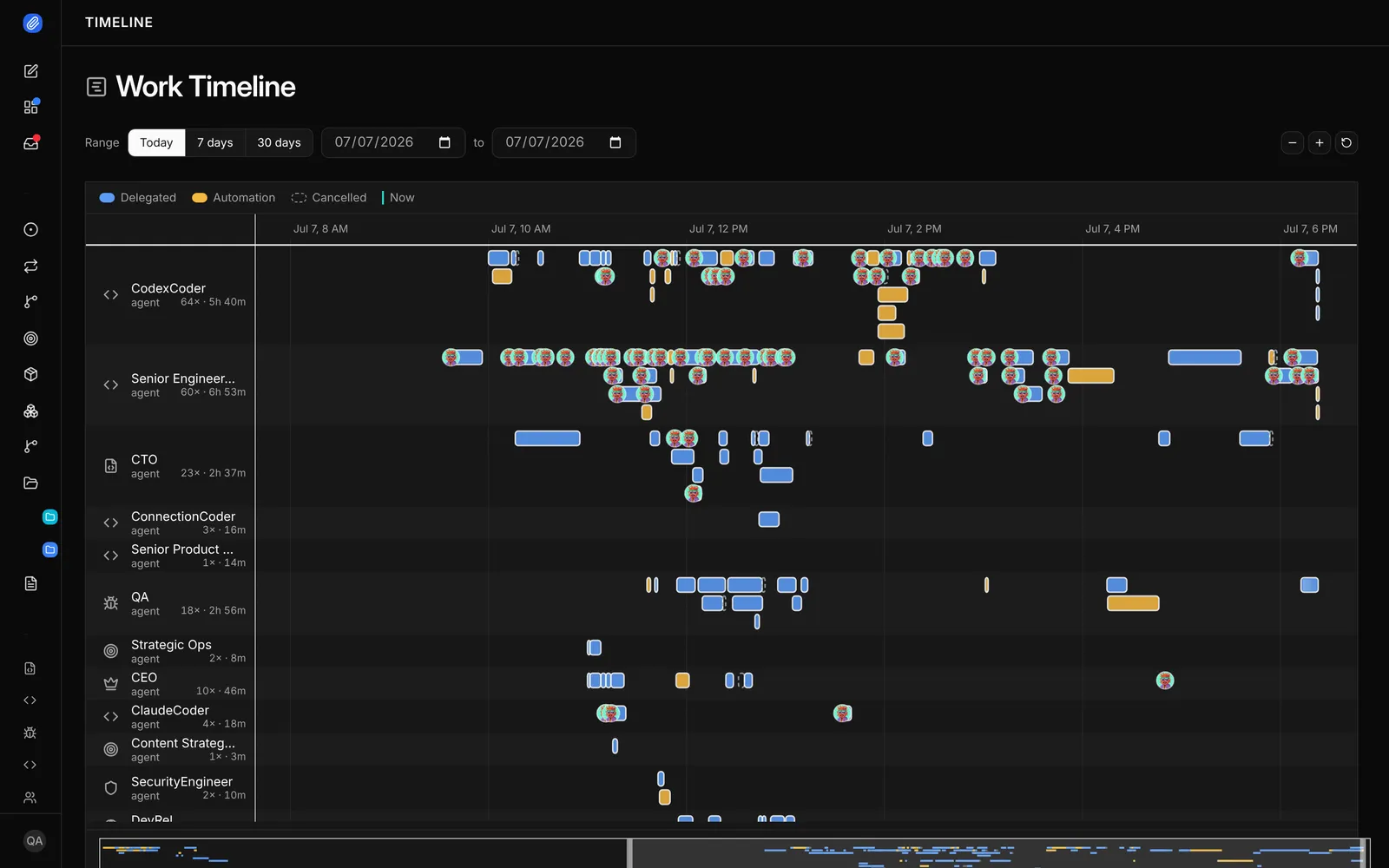
Every Paperclip task has one owner, linked goals, dependencies and an activity log that attributes work to the responsible person. A task’s Execution Policy can require a Review stage and an Approval stage before completion. People or agents approve the work before it ships, and requested changes go back to the agent.
Paperclip also governs external tools across 40+ apps and any MCP server. You set each action to Off, Ask first or Allowed, and newly discovered actions stay quarantined until someone reviews them. In LangGraph, approvals and tool checks live in your graph code through interrupt() calls and middleware, so your team builds and hosts its own review queue and interface.
Budgets with a hard stop and one-command self-hosting
Paperclip enforces monthly company and agent budgets plus lifetime project budgets. At 80% by default, Paperclip records a warning and lets work continue. At 100% of recorded spend, Paperclip opens a hard-stop incident, pauses that scope, cancels queued and running runs and keeps tasks assigned until a board user raises the cap or the monthly window resets. Because enforcement checks recorded spend as runs finish, runs already in flight can push total spend past the cap, and subscription logins record $0.
Open-source LangGraph has no built-in spending cap beyond step or recursion limits in code. LangSmith adds cost alerts and spend policies through its commercial LLM Gateway.
Self-hosting also looks different. Paperclip runs as a local server with an embedded Postgres database from one command (npx paperclipai@latest onboard --yes) on Node.js 24.11 or newer. You can self-host the LangGraph library inside any Python or Node service for free, while self-hosting LangSmith Deployment (Agent Server, observability and enterprise access controls) requires a LangSmith Enterprise plan.
Use them together
Paperclip and LangGraph fit cleanly in the same stack when a team needs both custom workflows and off-the-shelf coding agents.
Build your custom stateful graph in LangGraph for domain-specific work such as document extraction, customer triage or multi-step research, and expose it as a script or HTTP service. Then register that workflow inside Paperclip using the built-in Process or HTTP adapter. Paperclip assigns it tasks, triggers it on routines or webhooks, routes its output through Review and Approval stages and tracks its budget alongside Claude Code, Codex and other team agents.
Each tool keeps its own job. LangGraph owns internal graph routing and step checkpoints inside your service, while Paperclip owns task assignment, human sign-off, team permissions and audit history across all agents.
- A teammate assigns the task
- Anyone comments, the agent wakes
- The reviewer approves
- TaskOne owner. A thread for the plan and results.
- The agent runsWoken by the task, a comment or a schedule.
- Work productPosted in the task thread with the diff or files.
- Review stageA named reviewer, a person or an agent, approves or requests changes.
- ApprovedThe task closes only after approval.
When to choose LangGraph
- You want to build custom stateful agent workflows in Python or TypeScript with explicit nodes, cycles and conditional routing.
- Your application needs step-level checkpoint persistence, fault recovery and time-travel debugging inside the graph itself.
- You are embedding an agent inside a customer-facing product and need a code library rather than an internal team control plane.
- Your team already uses LangSmith for tracing, evaluations and prompt management and wants managed Agent Server hosting with enterprise SLAs.
- You want custom human-in-the-loop checkpoints wired directly into your own web or app interface.
When to choose Paperclip
- Your whole team shares the agents in one multi-player space, with roles, review and approval stages, budgets, and private projects and tasks for sensitive work.
- You want open-source agent orchestration with governance under the MIT license, self-hosted with one command and no per-seat fees.
- You already use Claude Code, Codex, Gemini CLI, Cursor, OpenCode or Hermes and want to run them across opt-in git worktrees without writing agent framework code.
- You need company, agent and project budgets that pause work at 100% of recorded spend instead of relying on alerts alone.
- You want to govern coding agents and custom HTTP or process workflows, including LangGraph services, under one task queue and activity history.
FAQ
How does Paperclip compare to LangGraph for open-source agent orchestration with governance?
LangGraph is an MIT-licensed Python and TypeScript framework for building stateful agent workflows with step checkpoints and code-level interrupts. Paperclip is an MIT-licensed multi-player control plane that runs coding and operational agents with built-in task ownership, review and approval stages, per-action connector rules and budgets that pause at 100% of recorded spend. Pick LangGraph to write custom agent graphs in code, or pick Paperclip to govern a shared team of agents without building a control plane yourself.
Is LangGraph completely open source and free to self-host?
The core LangGraph Python and JavaScript libraries are MIT-licensed and free to self-host in your own application. LangSmith, which adds team workspaces, observability, Agent Server hosting and Fleet, is commercial software. Its Developer plan is free for 1 seat, Plus starts at $39 per seat a month plus usage, and self-hosted LangSmith Deployment requires a custom Enterprise plan. Paperclip ships its full server, web UI and team governance under the MIT license with no per-seat fees.
Can Paperclip run a LangGraph agent?
Yes. Paperclip includes built-in Process and HTTP adapters, so you can invoke a LangGraph script or deployed LangGraph HTTP endpoint from a Paperclip task or routine. Paperclip tracks assignment, review stages, budgets and activity logs around the run, while LangGraph manages its own internal graph state and checkpoints.
How do approvals and human-in-the-loop compare?
LangGraph provides interrupt() in code, which pauses a graph, persists state to a checkpointer and resumes when your app passes Command(resume=...). Paperclip builds Review and Approval stages directly into every task and gives each connected app or MCP action a rule of Off, Ask first or Allowed without requiring custom review UI code.
Which one stops runaway agent spend?
Paperclip enforces monthly company and agent budgets plus lifetime project budgets in the open-source app. It warns at 80% by default and pauses the scope at 100% of recorded spend, though runs already in flight can push total spend past the cap. Open-source LangGraph has no built-in spend cap beyond code-level step limits, while LangSmith adds cost alerts and spend policies through its commercial LLM Gateway.
Can LangGraph run Claude Code or Codex in git worktrees?
No. LangGraph is a framework for building agents that call model APIs in Python or TypeScript rather than a coding-agent orchestrator. Paperclip runs Claude Code, Codex, Gemini CLI, Cursor, OpenCode and Hermes directly and can give each task its own git worktree through opt-in Isolated Workspaces.
What are Paperclip’s current limits compared to LangSmith?
Paperclip has no native desktop or mobile app, though its web UI is responsive and installable on a phone. Paperclip Cloud is still in an invitation-only beta, and chat channels are experimental. Paperclip is also a control plane rather than a dedicated LLM evaluation or prompt-tracing suite like LangSmith. For more comparisons, see our guide to Paperclip alternatives.
Sources
- LangChain, LangGraph product page, pricing, LangGraph Python overview, LangGraph JS overview, persistence, interrupts, LangSmith Deployment overview, self-hosted LangSmith, LangSmith Studio, LangSmith Fleet, LangSmith LLM Gateway, alerts, cron jobs, webhooks, RBAC and MCP adapters, checked November 24, 2026
- GitHub, langchain-ai/langgraph README and MIT license, 45,371 stars, checked November 24, 2026
- Paperclip, README, adapter overview, execution policy, connector action permissions and costs, 116,705 stars, checked November 24, 2026