Quick take
OpenClaw and Paperclip are not rivals. Paperclip runs OpenClaw as an agent, next to agents from other vendors. The Paperclip README puts it this way: “If OpenClaw is an employee, Paperclip is the company.” Use OpenClaw alone for a personal assistant in your chat apps, and add Paperclip when a whole team shares it with tasks and review.
At a glance
Scroll sideways to see both columns
| Capability | Paperclip | OpenClaw |
|---|---|---|
| Works with the other product | Yesruns OpenClaw as an agent, by invite | Yesjoins Paperclip with one invitation prompt, and its docs cover the pairing |
| Shared by a whole team | Yespeople and agents share one org chart, with the same tasks, threads and history | Partiala shared gateway for a team that trusts each other, with operator roles |
| Private projects and tasks | Yeschoose which people and agents can see each one | Partialroles and draft sessions limit who sees a session. Its docs call this a usability feature, not security |
| Apps and connections with a rule for each action | Yes40+ apps and any MCP server, each action Off, Ask first or Allowed | Partialallow and deny lists for each tool, and command approvals that can ask first, set for each agent |
| Shared skills | Yesone library for the whole company, written and tested in Skill Studio | Yesthe ClawHub marketplace, and personal skills you can share with the team |
| Is an assistant itself | NoPaperclip runs agents from other vendors | Yeswith its own memory, skills and device actions |
| Runs Claude Code, Codex and other coding agents | YesClaude Code, Codex, Gemini CLI, Cursor, OpenCode, Hermes and more | Yesa Codex plugin, and Claude Code through its attach command |
| Memory across sessions | Nocontext lives in tasks, threads and documents | Yesbuilt-in memory with search |
| Task board | Yestasks with one owner, a thread and a project | Yesa Workboard with cards and statuses |
| Git worktree for each task | Yesopt-in with Isolated Workspaces | Yesmanaged worktrees, opt-in for most sessions |
| Review and approval built into every task | Yespeople or agents approve the work before it ships, and changes go back to the agent | Partialyou approve commands from a chat app, and the Workboard has a review status |
| Budget with a hard stop | Yescompany, agent or project in money, pauses at 100% | Partialan optional token budget for each goal. No money budget for agent runs in its docs |
| Routines: scheduled and webhook-triggered work | Yesroutines with schedules, webhooks and Run now, each run is a task | Yescron schedules, webhooks and Gmail triggers |
| Chat channels | Yesexperimental: Slack, Discord, Teams, Telegram, GitHub and email | YesWhatsApp, iMessage, Telegram, Slack, Discord, Signal and more |
| Native desktop app | Noinstallable web UI | YesmacOS, Windows and Linux |
| Mobile | Yesresponsive web app you can install on your phone | YesiOS and Android apps |
| Hosted option | YesPaperclip Cloud, join the waitlist | Noit has no hosted service |
| Open source | YesMIT | YesMIT, run by the nonprofit OpenClaw Foundation |
What OpenClaw does well
OpenClaw has reach. One assistant answers in WhatsApp, iMessage, Telegram, Slack, Discord, Signal and more than 20 channels in total. You talk to it where you already talk to people.
You own all of it. The README says that your state, memory and credentials stay on your own hardware. OpenClaw has no paid plan and no hosted service, and a nonprofit foundation runs the project.
It has native apps everywhere. There are apps for macOS, Windows and Linux, and companion apps for iOS and Android. Through them, the assistant can use voice, the camera and the screen.
It has a large ecosystem. Skills and plugins come from its ClawHub marketplace, and models and coding agents are plugins that you can swap, Claude and Codex included.
OpenClaw has also grown past one person. A shared gateway lets a trusted team use one assistant, with operator roles. It has a Workboard with cards and managed git worktrees for coding sessions.
On November 12, 2026 OpenClaw had 394,411 GitHub stars.
Where Paperclip differs
A team space with permissions
OpenClaw’s team mode shares one gateway. Its own docs call a shared gateway “one trust domain” and say to run separate gateways for people who don’t trust each other. Paperclip is built for a whole team. People and agents share one org chart with roles and permissions. You choose who can use each connection, and you can mark a project or a task private.
Agents from several vendors, with an org chart
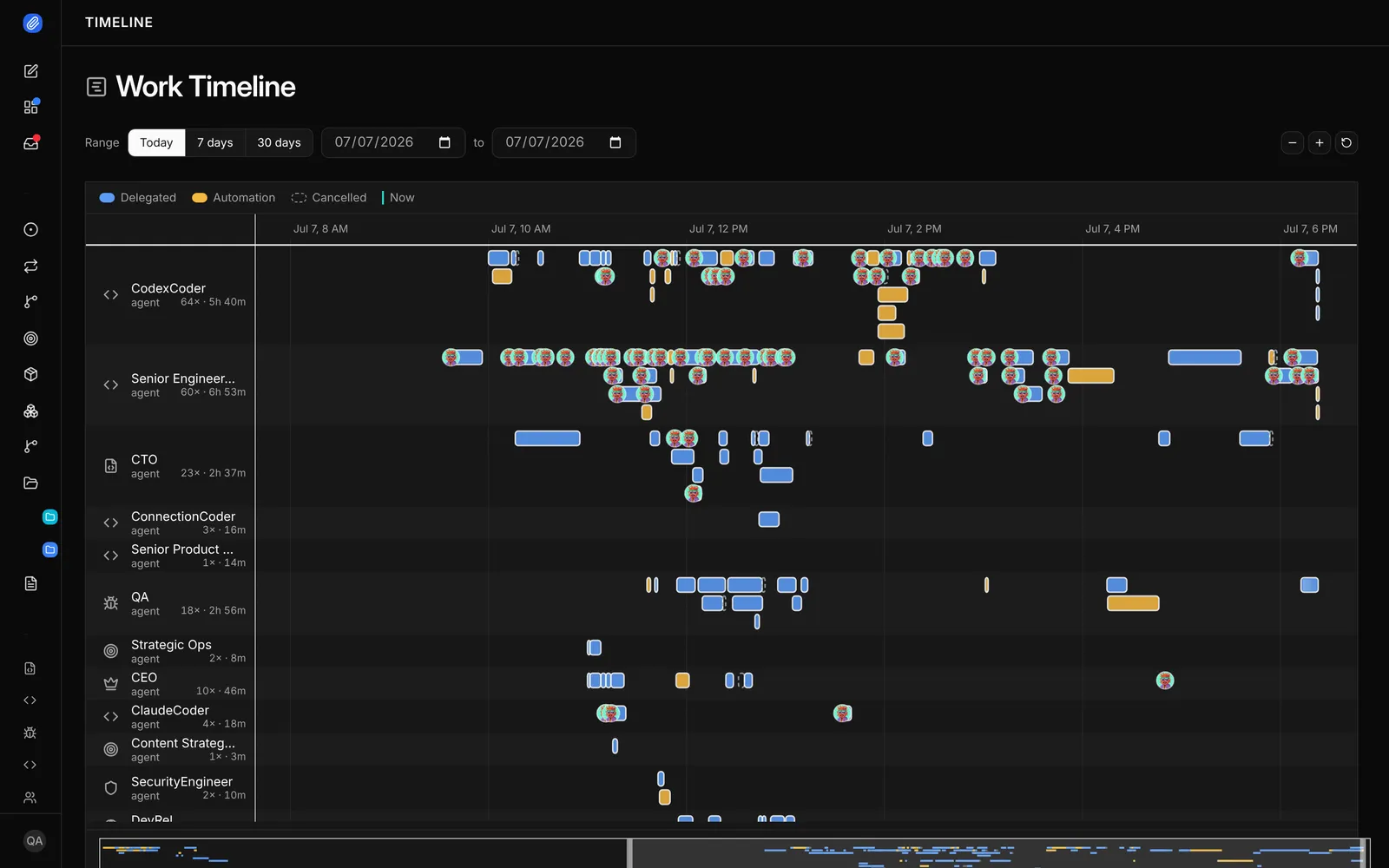
OpenClaw is one assistant that can start workers. Paperclip is a team of agents with roles and reporting lines. OpenClaw can sit next to Claude Code, Codex and Hermes. A manager agent can split a plan into tasks, and a different agent can review the result.
Review on the finished task
In OpenClaw you approve risky commands from a chat app, and a Workboard card can wait in a review status. Paperclip adds a sign-off on the finished work. A task can have a Review stage and an Approval stage, and a person or another agent approves the result or sends it back.
Budgets in money, for agents that report cost
A Paperclip budget applies to the company, one agent or one project, in money. It warns at 80% by default and pauses the agent at 100%. Paperclip enforces budgets from the spend that runs report. The OpenClaw gateway docs don’t describe cost reporting, so don’t rely on a budget to stop OpenClaw runs. OpenClaw itself tracks usage and can set a token budget for a goal.
Use them together
Paperclip runs OpenClaw as an agent. In Paperclip, choose New Agent, then Invite an external agent, then Other. Paste the invitation prompt into OpenClaw’s main chat and approve the join request. Paperclip then sends tasks to the OpenClaw gateway, and each task gets its own OpenClaw session.
OpenClaw’s own docs cover the first connection. Paperclip tries to pair on its own. If it reports that pairing is required, approve the pending device in OpenClaw and run the task again.
The steps are in the OpenClaw integration guide.
- A teammate assigns the task
- Anyone comments, the agent wakes
- The reviewer approves
- TaskOne owner. A thread for the plan and results.
- The agent runsWoken by the task, a comment or a schedule.
- Work productPosted in the task thread with the diff or files.
- Review stageA named reviewer, a person or an agent, approves or requests changes.
- ApprovedThe task closes only after approval.
When to choose OpenClaw
- You want a personal assistant on your own devices that answers in your chat apps.
- You want native desktop and phone apps, with voice, camera and screen actions.
- A small group of people who fully trust each other wants to share one assistant.
- You want everything free and on your own hardware, with no vendor.
When to choose Paperclip
- Your whole team shares the agents, with roles, review and approval, budgets, and private projects and tasks for sensitive work.
- You want OpenClaw on the same team as coding agents from other vendors.
- You want a review or an approval on the finished task.
- You want budgets in money for the agents on the team that report their cost.
- You want one task history that every teammate can read.
FAQ
Is Paperclip a replacement for OpenClaw?
No. OpenClaw is an assistant, and Paperclip runs assistants and agents as a team. You can run OpenClaw inside Paperclip.
Should I use Paperclip or OpenClaw to manage several agents in parallel?
For your own sessions, OpenClaw’s Workboard and worktrees can do it. For a team, or for agents from several vendors, use Paperclip. It gives each agent tasks, a manager and a place in the org chart.
How do the approvals compare?
OpenClaw approves commands as the assistant works. Paperclip approves the finished task, with Review and Approval stages, and keeps an activity history of who did what.
How do I connect OpenClaw to Paperclip?
Copy the invitation prompt from Paperclip, paste it into OpenClaw and approve the join. The OpenClaw integration guide has the steps.
How do Hermes, OpenClaw and Paperclip fit together?
Hermes and OpenClaw are agents. Paperclip is the team space that can run both. See Paperclip vs Hermes.
Sources
- OpenClaw, multiplayer guide, Workboard, managed worktrees, platforms, usage tracking, goals, exec approvals, skills, attach, devices and Paperclip pairing and scheduled jobs, checked November 12, 2026
- GitHub, openclaw/openclaw README, 394,411 stars, checked November 12, 2026
- Paperclip, README, bring your own agent and OpenClaw Gateway adapter, 113,373 stars, checked November 12, 2026