Quick take
Herdr and Paperclip both run Claude Code, Codex and other coding agents. Herdr is a native app for one developer that keeps agents running in terminals and shows which one needs you. Paperclip is a server for a team, where people and agents share tasks with review and budgets. Pick Herdr if you work alone and stay close to your terminals, and pick Paperclip if your whole team shares the agents.
At a glance
Scroll sideways to see both columns
| Capability | Paperclip | Herdr |
|---|---|---|
| Shared by a whole team | Yespeople and agents share one org chart, with the same tasks, threads and history | Nono accounts. Each person runs their own copy |
| Private projects and tasks | Yeschoose which people and agents can see each one | Nono accounts or tasks |
| Apps and connections with a rule for each action | Yes40+ apps and any MCP server, each action Off, Ask first or Allowed | Nonot in its docs |
| Shared skills | Yesone library for the whole company, written and tested in Skill Studio | Partiala public gallery of shared layouts and add-ons, no team skill library |
| Chat channels | Yesexperimental: Slack, Discord, Teams, Telegram, GitHub and email | Nonot in its docs. Its phone apps show which agent needs you |
| Runs Claude Code, Codex and other coding agents | YesClaude Code, Codex, Gemini CLI, Cursor, OpenCode, Hermes and more | YesClaude Code, Codex, Copilot CLI, Cursor, OpenCode and anything that runs in a terminal |
| Shows which agent needs you | Yesan inbox of tasks that wait for you | Yesevery terminal is marked working, blocked, done or idle |
| Git worktree for each task | Yesopt-in with Isolated Workspaces | Yesyou open a worktree for each branch |
| Review and approval built into every task | Yespeople or agents approve the work before it ships, and changes go back to the agent | Nonot in its docs |
| Budget with a hard stop | Yescompany, agent or project, pauses at 100% | Nonot in its docs |
| Routines: scheduled and webhook-triggered work | Yesroutines with schedules, webhooks and Run now, each run is a task | Nonot in its docs |
| Work continues after you close the laptop | Yesa server wakes agents on tasks, comments and schedules | Partialagents keep running when you close the app. After a reboot, the desktop app starts fresh shells |
| Several machines in one view | Partialone server, with remote environments as an experimental feature | Yesyour laptop and SSH machines in one window |
| Native desktop app | Noinstallable web UI | YesmacOS on Apple silicon, Linux and Windows |
| Mobile | Yesresponsive web app you can install on your phone | YesiPhone, iPad and Android apps |
| Noaccount needed | Yesthe local install needs no Paperclip account | Yesno accounts at all |
| Hosted option | YesPaperclip Cloud, join the waitlist | Noit runs on your machines |
| Open source | YesMIT | YesApache 2.0 |
What Herdr does well
Herdr answers one question fast: which agent needs me? Every terminal is marked working, blocked, done or idle. Some agents report their own state, so you don’t have to read each screen.
Your terminals outlive the window. Agents run in a small background server called herdr-core. You can close the app or lose your SSH connection, and the agents keep going.
It works across machines with no account. Your laptop and your SSH machines appear in one window, and nothing passes through a Herdr server. The free iPhone, iPad and Android apps connect to the same machines over SSH.
Herdr is built to be changed. Agents can start helper agents, message them and wait for them. You change layouts, keys and add-ons by asking your agent, and the site has a gallery of shared layouts.
Herdr is free under the Apache 2.0 license. On November 12, 2026 its terminal app repository had 50,583 GitHub stars, and its desktop app repository had 2,802.
Where Paperclip differs
One developer or a whole team
Herdr has no accounts and no sharing. It is your own view of your own agents. Paperclip is multi-player. People and agents share one org chart, and everyone sees the same tasks, threads and run history. Anyone on the team can assign a task to an agent or to a person. Roles and permissions decide who can do what, and you can mark a project or a task private.
Tasks with one owner
In Herdr the unit of work is a terminal that you watch. In Paperclip it is a task with one owner. You write the task and assign it, and the agent wakes to do it. The thread records what happened, so a teammate can read it later without your terminal.
Review, budgets and schedules
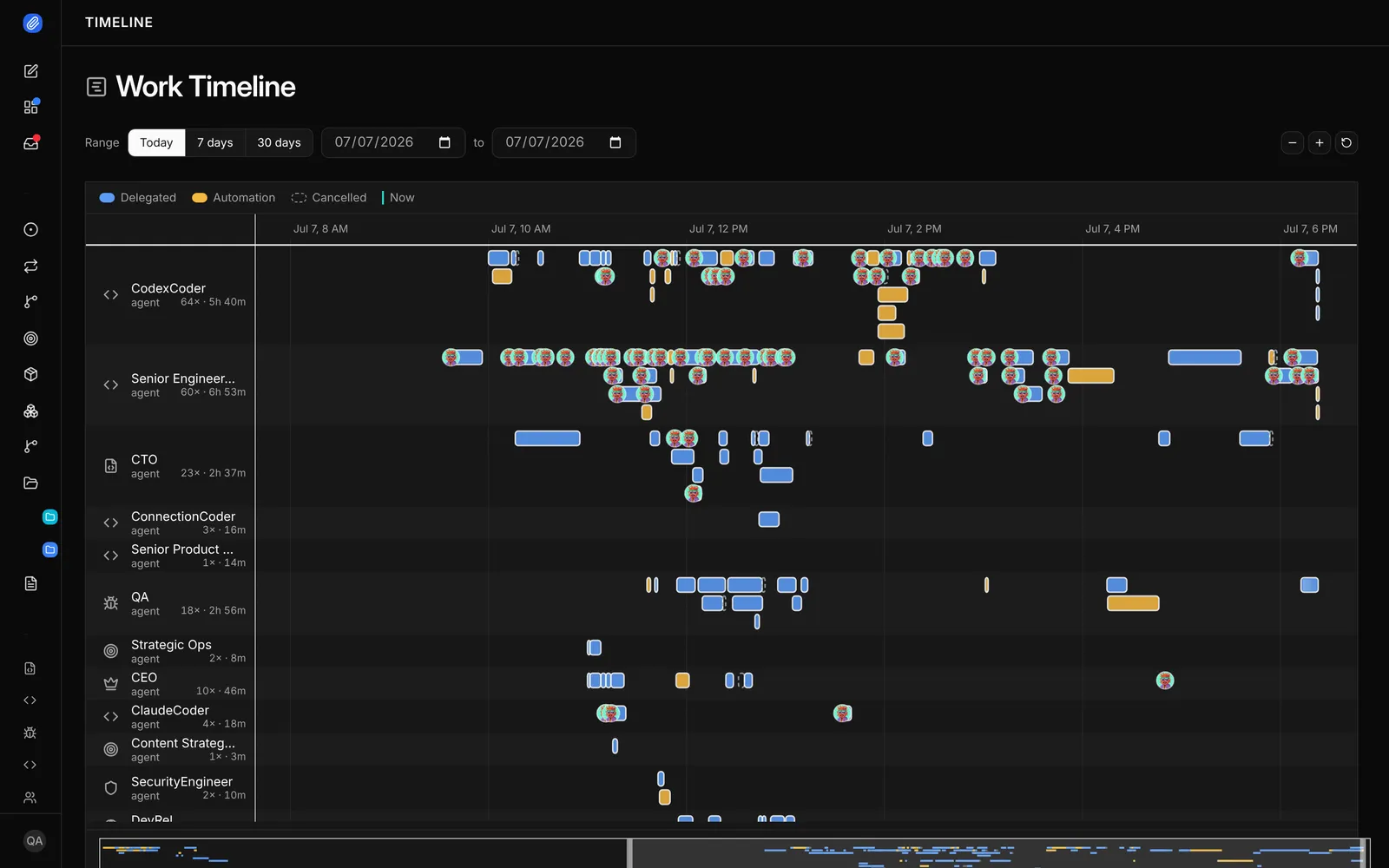
Paperclip adds controls for work that nobody watches. A task can need review or approval before it closes. A budget pauses an agent at 100% of its limit. A routine starts work on a schedule or from a webhook. Herdr’s site and docs describe none of these.
A server that survives a restart
Paperclip runs as a server. Its tasks and wake-up queue live in a database, so assigned work is still there after a restart. Herdr keeps agents running while the machine is up. The desktop app’s README says that after a reboot, kept panes get fresh shells. The terminal app can resume supported agent sessions.
Use them together
There is no documented integration between Herdr and Paperclip. Both run the same agents, such as Claude Code, Codex and OpenCode, but nothing connects a Paperclip task to a Herdr terminal. Some developers may use Herdr for their own hands-on sessions and Paperclip for the team’s shared work.
- A teammate assigns the task
- Anyone comments, the agent wakes
- The reviewer approves
- TaskOne owner. A thread for the plan and results.
- The agent runsWoken by the task, a comment or a schedule. Optional git worktree.
- Pull requestThe agent opens it with its own git and gh.
- Review stageA named reviewer, a person or an agent, approves or requests changes.
- ApprovedThe task closes only after approval.
When to choose Herdr
- You are one developer who runs several coding agents in terminals.
- You want to see at a glance which agent is blocked.
- You want a native desktop app and a phone app, with no server and no account.
- You work across your laptop and a few SSH machines and want one list of agents.
- You like to change the tool itself by asking your agent.
When to choose Paperclip
- Your whole team shares the agents, with roles, review and approval, budgets, and private projects and tasks for sensitive work.
- You want work to continue from a task queue when nobody is at a terminal.
- You want a review or an approval before a task closes.
- You need a spending limit that pauses the agent.
- You want schedules and webhooks to start work.
- The same agents also handle support, marketing or operations.
FAQ
What is Herdr?
Herdr is a free desktop app, terminal app and background server for running coding agents. It shows the state of every agent and keeps terminals running when you close the window.
Does Herdr work for a team?
Not as a shared space. Herdr has no accounts or roles. Each person runs their own copy on their own machines.
Does Herdr have git worktrees?
Yes. You can ask your agent to open a worktree for a branch, and the terminal app has worktree commands.
Do agents keep running when I close my laptop?
In Herdr, agents on a remote SSH machine keep running, and agents on your laptop run while the laptop is awake. In Paperclip, agents run from the server, so put the server on a machine that stays on.
Is Herdr free?
Yes. The apps are free and open source under Apache 2.0, with no paid plan on the site.
Sources
- Herdr, homepage, herdr-core, mobile apps, guide, supported agents and session state, checked November 12, 2026
- GitHub, herdrdev/herdr with 50,583 stars and herdrdev/herdr-app with 2,802 stars, checked November 12, 2026
- Paperclip, README and docs, 113,373 stars, checked November 12, 2026