Quick take
OpenHands and Paperclip both run Claude Code, Codex and other coding agents on your own machines. OpenHands Agent Canvas is a control center for conversations with agents, with optional Docker sandboxes and its own OpenHands agent. Paperclip is a shared team space, where people and agents work from the same tasks. Pick OpenHands for its agent, its sandboxes or its SDK, and pick Paperclip when your whole team shares the agents.
At a glance
Scroll sideways to see both columns
| Capability | Paperclip | OpenHands |
|---|---|---|
| Shared by a whole team | Yespeople and agents share one org chart, with the same tasks, threads and history | Partialmulti-user accounts and roles on the Teams plan, $500 a month for 10 users. The free edition has one shared login |
| Private projects and tasks | Yeschoose which people and agents can see each one | Partialconversations are private to each member of an organization. No private projects in its docs |
| Apps and connections with a rule for each action | Yes40+ apps and any MCP server, each action Off, Ask first or Allowed | PartialGitHub, GitLab, Bitbucket, Slack and Jira integrations, plus a confirmation policy for risky actions |
| Shared skills | Yesone library for the whole company, written and tested in Skill Studio | Yesorganization-wide skills from a shared repository |
| Chat channels | Yesexperimental: Slack, Discord, Teams, Telegram, GitHub and email | Yesmention it in Slack, and Jira Cloud on Enterprise |
| Runs Claude Code, Codex and other coding agents | YesClaude Code, Codex, Gemini CLI, Cursor, OpenCode, Hermes and more | YesClaude Code, Codex, Gemini CLI, Pi, OpenCode and any ACP agent |
| Its own coding agent | NoPaperclip runs agents from other vendors | Yesthe OpenHands agent |
| Isolated workspace for each task | Yesa git worktree for each task, opt-in with Isolated Workspaces | Yesan optional Docker container for each conversation, or a git worktree for each agent |
| Review and approval built into every task | Yespeople or agents approve the work before it ships, and changes go back to the agent | Partialyou confirm agent actions as they run, and an automation can review pull requests |
| Budget with a hard stop | Yescompany, agent or project, pauses at 100% | Partialmonthly spend limits for the organization and each member on paid plans, with requests blocked at the limit |
| Routines: scheduled and webhook-triggered work | Yesroutines with schedules, webhooks and Run now, each run is a task | Yesautomations on a schedule or on events, such as Slack and GitHub |
| Work continues after you close the laptop | Yesa server wakes agents on tasks, comments and schedules | Yesrun the backend on a server |
| Org structure for agents | Yesorg chart with reporting lines and delegation | Nonot in its docs |
| SDK for your own products | No | Yesan SDK for building agents into your own tools |
| Native desktop app | Noinstallable web UI | Partialan early-preview desktop app for macOS, Windows and Linux |
| Mobile | Yesresponsive web app you can install on your phone | Partialthe web UI works from a phone once you host it behind a domain |
| Self-hosted | Yesa local server, one command | Yesnpm or Docker |
| Hosted option | YesPaperclip Cloud, join the waitlist | PartialOpenHands Cloud exists, with no price on the pricing page |
| Open source | YesMIT | YesMIT |
What OpenHands does well
OpenHands gives you a choice of agents in one window. It ships its own OpenHands agent, and Agent Canvas also runs Claude Code, Codex, Gemini CLI, Pi, OpenCode or any agent that speaks ACP. Each agent can use the subscription login that its CLI already stores, or an API key.
Its sandboxing is flexible. Agent Canvas can run each conversation in an optional Docker container, or give each agent its own git worktree. You can also point the UI at remote agent backends on VMs or on company infrastructure.
It comes with automations that are ready to use. Examples are Issue to Pull Request, a pull request review assistant and monitors for a Slack channel or a GitHub repository. Automations are part of the free edition.
OpenHands also has an SDK, so you can build coding agents into your own products. The paid team edition has a clear price: $500 a month for up to 10 users, self-hosted. It adds access roles, SAML sign-in and monthly spend limits. Its organization-wide skills come from a shared repository, and you can mention it in Slack.
On November 12, 2026 OpenHands had 93,341 GitHub stars.
Where Paperclip differs
Team features in the free app
Both products can serve a team. In OpenHands, the free Agent Canvas is for one user or one shared identity. Multi-user accounts, access roles and SAML sign-in are on the Teams plan. In Paperclip, people and agents share one org chart in the free open-source app. Everyone sees the same tasks, threads and run history. Roles and permissions decide who can do what, and you can mark a project or a task private.
Work organized as tasks
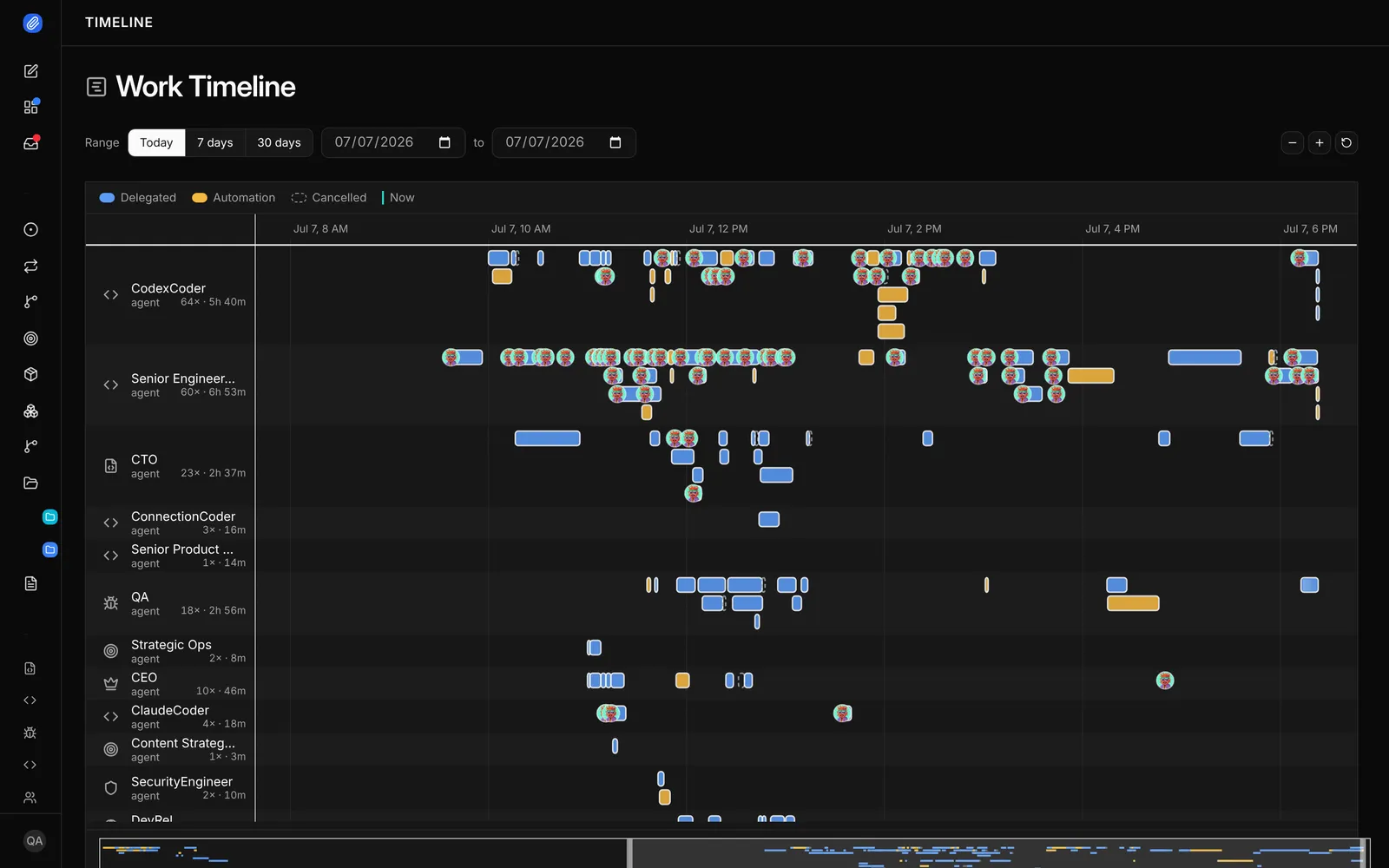
OpenHands is organized around conversations with an agent. Paperclip is organized around tasks. Each task has one owner, a thread, a project and a goal. An agent wakes when someone assigns it a task or comments on it, and the task records what the agent did. A manager agent can split a plan into tasks for other agents.
Review before a task closes
In OpenHands you can confirm an agent’s actions as it works, and an automation can post review comments on a pull request. Paperclip adds a sign-off on the finished work. A task can have a Review stage and an Approval stage. A person or another agent approves the result, or sends it back to the agent with a comment.
Budgets on the company, an agent or a project
Both products can stop spending at a limit. OpenHands sets monthly spend limits for an organization and for each member. At the limit, it can block new model requests. These limits are on the paid plans. A Paperclip budget applies to the company, one agent or one project. It warns at 80% by default and pauses the agent at 100%, and it is part of the free app.
Use them together
There is no documented integration between OpenHands and Paperclip. Both can run the same agents, such as Claude Code and Codex, but nothing connects a Paperclip task to an Agent Canvas conversation. Most teams pick one.
- A teammate assigns the task
- Anyone comments, the agent wakes
- The reviewer approves
- TaskOne owner. A thread for the plan and results.
- The agent runsWoken by the task, a comment or a schedule. Optional git worktree.
- Pull requestThe agent opens it with its own git and gh.
- Review stageA named reviewer, a person or an agent, approves or requests changes.
- ApprovedThe task closes only after approval.
When to choose OpenHands
- You want the OpenHands agent itself, or an SDK to build coding agents into your own product.
- You want each conversation in its own Docker sandbox.
- You are one developer who wants a local control center for several coding agents.
- Your company wants a vendor-backed team edition with SAML sign-in at a published price.
When to choose Paperclip
- Your whole team shares the agents, with roles, review and approval, budgets, and private projects and tasks for sensitive work.
- You want those team features in the free MIT-licensed app.
- You want work organized as tasks with one owner, a thread and a history.
- You want a review or an approval before a task closes.
- You want a budget on one agent or one project, in the free app.
- The same agents also handle support, marketing or operations.
FAQ
Is OpenHands a coding agent or an orchestrator?
It is both now. OpenHands has its own coding agent, and Agent Canvas runs that agent next to Claude Code, Codex and others.
Can OpenHands run Claude Code and Codex?
Yes. Agent Canvas runs them through ACP, with the login that each CLI stores or an API key.
What does OpenHands cost for a team?
The Teams plan costs $500 a month for up to 10 users, and $50 a month for each extra seat. Agent Canvas for one user is free. Prices are from November 12, 2026.
Does OpenHands have budgets and approvals?
Its paid plans set monthly spend limits, and you can confirm agent actions as they run. We could not find a step where a person approves a finished task.
Can I use OpenHands with Paperclip?
There is no documented integration. Both run the same agents, so you can move between them without changing your agent subscriptions.
Sources
- OpenHands, homepage, pricing, ACP agents, Agent Canvas, prebuilt automations, budgets, roles and permissions, organization skills, integrations, Slack, August 2026 update and SDK security guide, checked November 12, 2026
- GitHub, OpenHands/OpenHands README and self-hosting guide, 93,341 stars, checked November 12, 2026
- Paperclip, README and docs, 113,373 stars, checked November 12, 2026